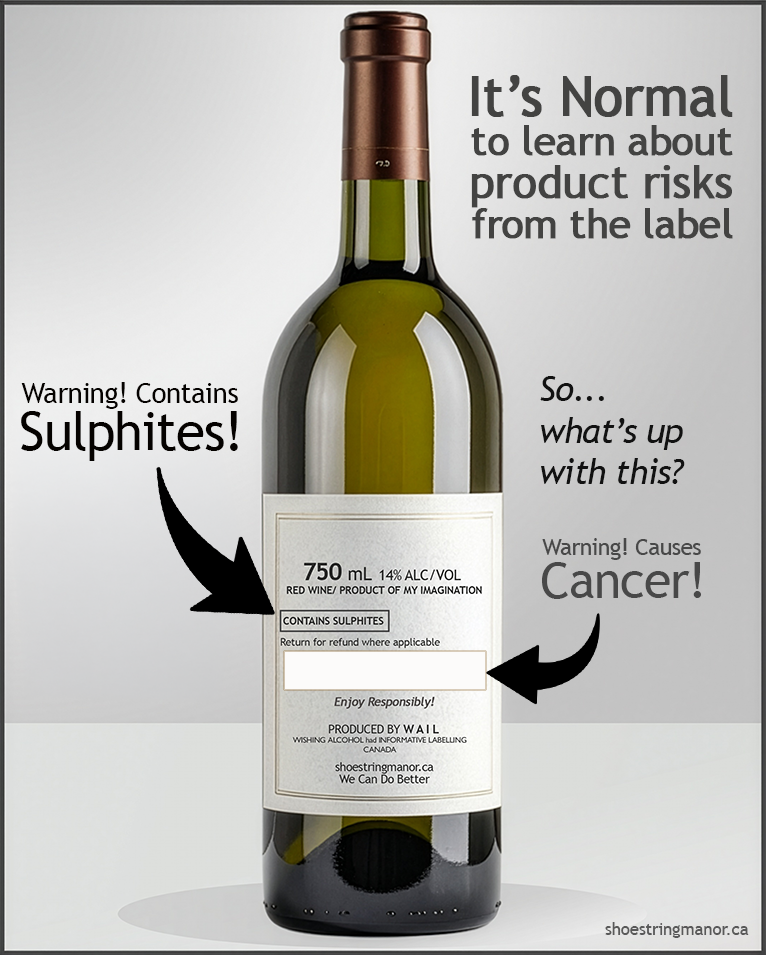
This isn’t really about labels.
Labels are just the visible part.
Product labels tell you the important things.
The part that says, publicly and without apology:
This product carries risk.
For years, blinded by alcohol culture, I smoothed over information. Even as a cancer survivor, I smoothed over the cancer warnings.
I’d see headlines saying alcohol causes cancer and think,
Didn’t we know that already? Didn’t everyone know that already?
Then I’d move on.
But knowing something and absorbing it aren’t the same thing.
Looking back, I wasn’t ignoring the information. I was filtering it through a culture that had taught me alcohol was normal, expected, and harmless. MADD has done an incredible job of shining a light on drinking and driving, but I don’t remember hearing much about cancer, addiction, dependence, or the countless other harms linked to alcohol.
Some people know alcohol can damage the liver. Some know it can destroy families. Some know it can cause cancer.
Yet somehow those facts float around disconnected from the bottle sitting on the table.
Those harms belong to “other people.”
Not people like us.
That’s alcohol culture.
It’s abnormal dressed up as normal.
And after a while, it starts to feel like reality.
That’s why warning labels matter.
Not because a label will make people stop drinking.
Not because sales will suddenly collapse.
Not because anyone imagines a sticker can solve addiction.
Labels do something simpler.
They force an acknowledgment.
We put warnings on products when we believe people deserve to know the risks.
We do it with tobacco.
We do it with medications.
We do it with chemicals under the kitchen sink.
But alcohol?
One of the few products that can cause cancer, dependence, disease, injury, and death still manages to present itself as celebration, relaxation, and fun.
The absence of a warning sends a message too.
It says:
Nothing important to see here.
Maybe nobody changes their behaviour because of a label.
Maybe most people glance at it and carry on.
But maybe someone doesn’t.
Maybe another mother’s son pauses in front of the cooler for a second.
Maybe he remembers a conversation.
Maybe he thinks about his health.
Maybe he thinks about someone he loves.
Maybe he drives past the liquor store tonight.
Just tonight.
And if enough people have that moment, the label has already done its job.
It has started, just a little, to change the way we think about alcohol.
To lift the veil society has draped over the subject.
Because the goal was never the sticker.
The goal was making the truth impossible to ignore.